By going to the history/archives on the right you may bring up each month. The history/archives also hold various expedition stories from past years- just click on the year and month.
Unfortunately blogs are posted on top of each other so each section needs to be read in order from the BOTTOM. A quicker way to scroll to what you want rather than going to the archives on the right is to click on "Older Posts" at the bottom of the page.
All photos may be clicked on to bring up full size. If you bring one photo up full size just keep clicking on it to scroll through all the photos in that post
Sunday, November 8, 2015
Vietnam Motorcycle Trip
After meeting an old friend, Mike Baker, in Bowen I was invited to join him on a week long motorcycle trip in Vietnam through the mountains on the China border accompanied by his son Cal and mate Dan from Adelaide.
We arrived in Hanoi and went to the Mototours Asia shop to be issued with bikes and meet our guide, a pleasant young fellow named Quin. Here we also joined up with two local residents in the form of Niko, an Italian and Manu, a Frenchman.
The traffic in Hanoi is not too hectic but the roads are infested with small scooters and motorcycles operating on the no-rules, just keep moving principal found in most Asian countries. The bikes we were issued with were two Indian built Royal Enfield 500's and the rest Honda/Suzuki 250cc enduro bikes. It turned out that the comfortable but heavy plodding Enfields were quite unsuitable for the difficult tracks ahead. The enduro bikes were old and poorly maintained but we managed with worn tyres, poor brakes and no rear shock absorbers

.
Heading north out of Hanoi we were soon into the most beautiful picture post card country with vertical limestone pinnacles covered in jungle with terraced rice paddies in the narrow valleys. We had a bit of excitement when Mike confronted a truck on a narrow bridge (we were off the main road on gravel byways by this time). He grabbed a bit much front brake and was slammed down on the road from his Enfield resulting in a few scrapes and bruises.

Eventually arriving at our destination, a traditional house in a small village, we were treated to a great night in Bac Son. One large room dominated the wooden building and we set up our gear on what was basically a 7 man bed with individual mosquito nets. The host family went out of their way to provide a wonderful meal accompanied by cold beer and the everpresent home brewed powerful rice "wine". Those who could, sat cross legged on the floor while the rest of us sprawled in whatever position we could twist our legs.
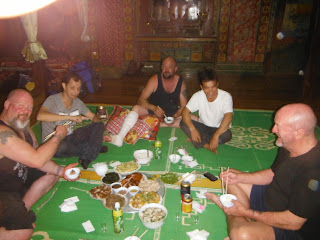 Cal, whose legs had swollen on the flight from Melbourne had not improved and was looking in a bad way. He was driven back to Hanoi where he continued to deteriorate so was flown out to the American Hospital in Bangkok. I dumped my Enfield and took over his trail bike while Quin took the Enfield giving Mike his much more agile trail bike.
The following days were filled with outstanding riding along narrow cliff top trails, crossing rocky rivers (drowned bikes) and being carried on bamboo rafts across wide rivers. We were way off the beaten track away from towns. The tracks at times were very precarious no more than a metre wide with 500 metre vertical drops off the side. The scenery was spectacular.


 We took a boat ride on Ba Be Lake along the "Apocalypse Now" style jungle lined river in misty conditions to where the water has cut a hole right through the mountain. There were more home stays, more rice wine and lots of parting company with our bikes. My worst injury is a sprained ankle though Manu broke his wrist on the last day but managed to ride to the finish. I think I might be getting a bit old fopr this enduro riding stuff.
The last day we were way out there right up on the China border. The hills are extremely rugged with few flat valleys. Right on top of a mountain we came upon an ethnic Hmong people market. The women all were dressed in the finest traditional intricate costumes. I particularly liked the used water buffalo market where the spiv salesment tried to convince the hoof-kickers to buy this particular model which had only ploughed 500 acres.


We finished in Lai Cai, a large town on the Chinese border and the end of the only rail line running to the north. We loaded the bikes on the train and had a comfortable trip in sleeping berths overnight back to Hanoi.
All in all a great trip mostly away from towns and traffic with quite a bit on foot or bike tracks devoid of any 4 wheel vehicles. The people were friendly, the villages were filthy (probably on average worse than other Asian countries) but the bigger cities OK, the scenery was spectacular.


We arrived in Hanoi and went to the Mototours Asia shop to be issued with bikes and meet our guide, a pleasant young fellow named Quin. Here we also joined up with two local residents in the form of Niko, an Italian and Manu, a Frenchman.
The traffic in Hanoi is not too hectic but the roads are infested with small scooters and motorcycles operating on the no-rules, just keep moving principal found in most Asian countries. The bikes we were issued with were two Indian built Royal Enfield 500's and the rest Honda/Suzuki 250cc enduro bikes. It turned out that the comfortable but heavy plodding Enfields were quite unsuitable for the difficult tracks ahead. The enduro bikes were old and poorly maintained but we managed with worn tyres, poor brakes and no rear shock absorbers

.
Heading north out of Hanoi we were soon into the most beautiful picture post card country with vertical limestone pinnacles covered in jungle with terraced rice paddies in the narrow valleys. We had a bit of excitement when Mike confronted a truck on a narrow bridge (we were off the main road on gravel byways by this time). He grabbed a bit much front brake and was slammed down on the road from his Enfield resulting in a few scrapes and bruises.

Eventually arriving at our destination, a traditional house in a small village, we were treated to a great night in Bac Son. One large room dominated the wooden building and we set up our gear on what was basically a 7 man bed with individual mosquito nets. The host family went out of their way to provide a wonderful meal accompanied by cold beer and the everpresent home brewed powerful rice "wine". Those who could, sat cross legged on the floor while the rest of us sprawled in whatever position we could twist our legs.

The following days were filled with outstanding riding along narrow cliff top trails, crossing rocky rivers (drowned bikes) and being carried on bamboo rafts across wide rivers. We were way off the beaten track away from towns. The tracks at times were very precarious no more than a metre wide with 500 metre vertical drops off the side. The scenery was spectacular.


The last day we were way out there right up on the China border. The hills are extremely rugged with few flat valleys. Right on top of a mountain we came upon an ethnic Hmong people market. The women all were dressed in the finest traditional intricate costumes. I particularly liked the used water buffalo market where the spiv salesment tried to convince the hoof-kickers to buy this particular model which had only ploughed 500 acres.


We finished in Lai Cai, a large town on the Chinese border and the end of the only rail line running to the north. We loaded the bikes on the train and had a comfortable trip in sleeping berths overnight back to Hanoi.
All in all a great trip mostly away from towns and traffic with quite a bit on foot or bike tracks devoid of any 4 wheel vehicles. The people were friendly, the villages were filthy (probably on average worse than other Asian countries) but the bigger cities OK, the scenery was spectacular.


Monday, July 13, 2015

Friday, July 10, 2015
Home


A nice run back to Cairns near Port Douglas.
8th In deference to Daisy we elected to travel the shortest distance to the bitumen straight south to Laura. There are some bitumen strips several kms long but in between it is the roughest section of road we have encountered. We stopped at Hann Roadhouse for a break before arriving at Laura late morning.
8th In deference to Daisy we elected to travel the shortest distance to the bitumen straight south to Laura. There are some bitumen strips several kms long but in between it is the roughest section of road we have encountered. We stopped at Hann Roadhouse for a break before arriving at Laura late morning.
Here we took more photos of the two Austin 7's together. The store owner at Laura has had one parked outside his roadhouse for many years so it is symbolic being able to have them side by side.
From Laura we are back on a lovely smooth road surface with no more white knuckle, heart in the mouth, bone rattling travel. We stopped at Palmer River roadhouse for a late lunch then made it to Mount Carbine where we checked into the caravan park and are able to secure a cabin overnight. This is not just two beds in a donga but the cheapest accommodation so far and the size of a small unit with all mod cons, very welcome.
9th We have a pleasant trip down the range into Mossman and then along the coast, arriving back in Cairns at midday having completed our circle with Daisy purring along and the two of us feeling very much more relaxed.
The trip has been great fun and we have been able to bring history alive which is what we set out to do, and we achieved our aim. Driving old cars though, especially under such rough conditions, you are constantly aware that you are testing the boundaries. Lang did a fantastic job driving the entire route and attending to all the mechanical needs Daisy required. Of our two New Zealanders in 1928 Hector only learnt to drive between Sydney and Cairns and he said in his book he was always happy, like me, to be the passenger. I can only imagine how difficult it was for them, no communications, no roads and no idea of what lay ahead, true pioneers who should not be forgotten.
Total distance covered from Cairns to Cape York and back was 1,624 miles (2,598km). Total fuel used was 58 gallons/230 litres giving 43mpg in the old money – pretty good seeing we spent a lot of time crawling in third and even second gear. On the good sections we played it conservative and although Daisy would do much more, we sat on 35mph/60kmh. Several of our problems were caused by the huge load she was forced to carry. The corrugations are constant throughout the trip and although the Austin 7 rides nicely, effectively having no shock absorbers results in regular out of control "drift driving", particularly on corners.
A great little car for its day and it would have been a winner on the English country lanes for which it was designed. Just goes to show you can take any car anywhere as Dick and Hector proved in 1928. Back to the 4x4 for us for a while until we feel in the need of more more punishment.
Thursday, July 9, 2015
On to Musgrave


6th Off again with Daisy fixed and raring to go. Called into Moreton Telegraph Station and selected breakfast from their vast menu of pies or pies. Despite the culinary paucity it is a lovely green place for travellers to stay under shady trees with friendly staff. The road is still pretty crook and we decided not to sidetrack into Weipa for an extra couple of hundred km of corrugations. Just north of Archer River Daisy died and we discovered a fuel union had worked loose and all our petrol had slowly run out on the road (no fuel gauge in 1928 Austin 7's). A young couple with a couple of kids stopped and I jumped in with a jerry can to go 25km to Archer River for petrol and hitch a ride to return to Lang who was fixing the fuel line. Before I could leave Archer River Lang appeared having been refueled by Shane who was passing on his way to Weipa with a can of chainsaw fuel – Austin 7's will run on anything it seems. Having a petrol engine is becoming a serious remote area planning issue in this day of diesel engines in 90% of 4x4's.
We soon had camp set up and dived into the clear waters of the Archer to get rid of the dust.
7th Leaving the Archer we bounced over a terrible road towards Coen. There was no generator charge and after a bit of investigation it seems the primitive cut-out had failed although the generator was still working. We managed to get a charge by Lang revving the engine with me under the bonnet pushing the contact in but the rough road and gear changes caused the engine revs to drop and the contact to pop out. We figure the car will run for days on a full battery and we have switched off our stereo, Engel fridge, airconditioning and electric seat adjustment to reduce electrical consumption.
Musgrave Telegraph Station is a nice break with good food and a welcome cold beer.
Home again, home again, jiggedy jig
4th We did not get away from Seisia until early afternoon but decided to head south as far as we can during the afternoon. We are the only car on the ferry and at about 4pm we turned off on the Old Telegraph track to Sailors Creek to find a great spot beside the water with nobody for miles.. We had a refreshing swim in the creek followed by a nice meal under the stars. The car has been running well all day
5th Set off from our camp site and after refuelling at Bramwell Junction we decided to go into Bramwell Station again as they have had a horse race, bull riding, greasy pig etc festival on all weekend. After lunch we are off and all-but reach the main road when Lang detected a strange lurch and crunch and realised we had broken the right rear axle housing completely off the differential.
We limped back into the homestead and Lang and the station truck driver welded the crack.The light axle was also fitted with a neat cross support brace under the differential like off-road race trucks to cope with any further excess overloads.
We decided to stay the night at Bramwell Station and enjoy the live entertainment once more.


Typical road - nowhere near the worst.

We make Cape York
2nd Lang headed off to the garage and worked there all day with Mark at Top End Motors rebuilding the brakes and the leaking radiator. I went down to the wharf and managed to get on the ferry over to Thursday Island where I spent the day. It certainly has changed since we were here 30 years ago!
3rd We are off early to head for the tip. The road is pretty rough but we cover the 34kms to Cape York by 09.30 despite drowning Daisy in a deep creek crossing. As it was low tide we were able to take Daisy onto the beach for photos of our arrival. Lang and I walked out to the tip and by the time we returned the car park was filling up and on the way out we passed dozens of 4WD's all heading to set foot on Australia's northern most point. The road from Bamaga to the tip is the roughest so far and we were limited to second and third gear on the corrugations.
A bit deep for Daisy - nearly made it.
A bit deep for Daisy - nearly made it.

The famous Croc Tent Cape York road
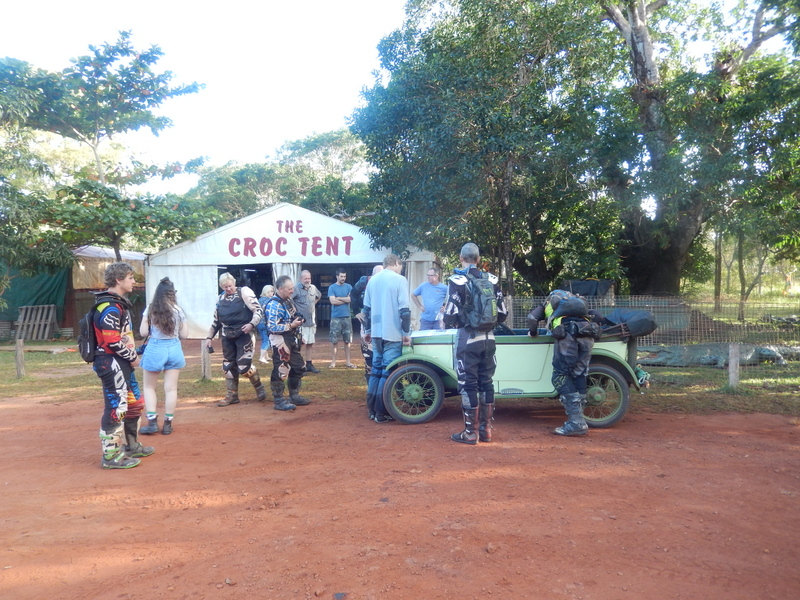
A lovely day at the tip.

Australia's most Northerly point.
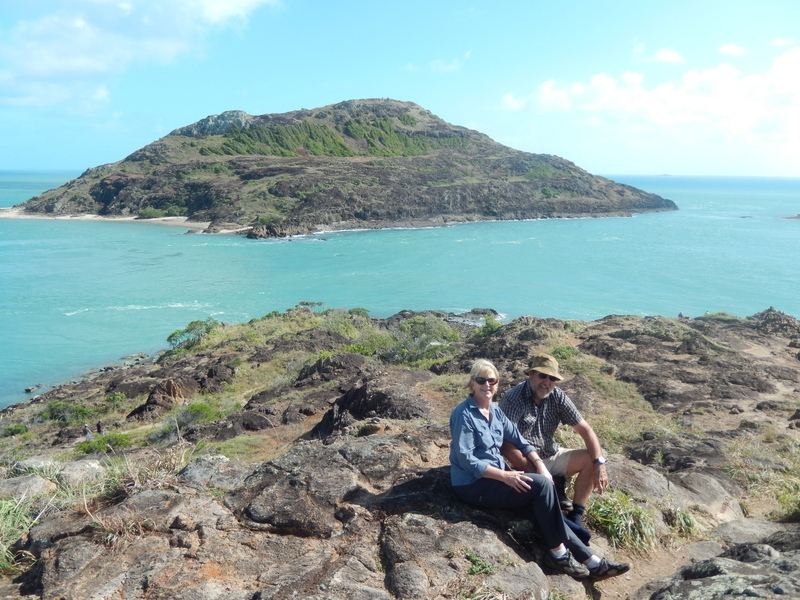
We are still having radiator problems so it is back to Top End Motors for some more repairs.
Bramwell to Seisia
No brakes so we had a get-away line onto the Jardine barge.

An Injinou family.


Kids everywhere loved Daisy

1 July Before setting off Lang had to fix the accelerator cable and then we went 10km to Bramwell Junction Roadhouse and refuelled. We are getting 17kms to the litre so Daisy is proving very economical. She has a 20 litre tank and we are carrying two 10 litre jerry cans. During the day all brakes failed so Lang is just reading the road and using the gears, emergency stops are achieved by turning the ignition off.
We called in at Fruit Bat Falls which are lovely but over-run with 4WD's and people so continued on to the Jardine River Ferry crossing. Again there was a huge line up of vehicles and it took about an hour and the help of Tina, who was driving the car in line behind us, to cross. We tied a rope from her front to our rear so we didn't get away and go down the steep slope, across the barge, and end up in the Jardine. We had considered trying to reenact the 1928 crossing and even brought a large tarp with us to float the car across. Unfortunately there did not seem to be anybody who was willing to wade across the river with the crocodiles, Lang probably would have given it a try but this little duck certainly wasn't going to.
The roads again range from OK to awful and we eventually hit bitumen just out of Injanoo and headed through Bamaga and onto Seisia. This is a tiny but pretty seaside town with a very nice caravan park. What it also has is Mark the mechanic at Top End Motors. We organised to have Daisy looked at the following day and booked a donga at the park for the next three days..
Coen to Bramwell
30th We are off by 0700 with very few cars on the road through to Archer River. The road conditions vary from OK to downright awful. After refuelling at Archer River and having some breakfast we made the decision to not side-track into Weipa, and put Daisy through another extra 200kms of corrugations.
Turning onto the Telegraph Road we decided we had made the right decision as this part of the road seemed to be in much better condition. We called into Moreton Telegraph Station for lunch and continued onto Bramwell Station for the night. During the day we struck quite a bit of rain which made it fun when cars passed and the windscreen turned red. As the wiper does not want to work we found we could tilt the whole windscreen and wipe with paper towel each time someone passed us.
At Bramwell Lang with the help of Les, a volunteer at the station, again worked on the brakes which continue to give us problems.In the evening though, we were able to relax and enjoy a very nice meal and live music until 9pm.
A chance meeting with Alan and Jan Pike and a quick coffee in the bush.

Typical termite mound - no, they don't all face north!

Les and Lang fixing brakes.

Fruit Bat Falls. Great spot but too easy to get to for the herds travelling north.

Jardine barge on a busy day.

Cooktown to Coen
Crossing the Normanby River

On the 27th we set off from Cooktown in the rain.but the weather cleared once we were over the range. We forded the Normanby River on the Battlecamp Road with no problems and then struck out on the gravel which had a few corrugations but the car handled it well.
We arrived at Laura late morning and set up camp behind the pub. Daisy had her photo taken with the Austin 7 parked at the Laura Store. During the afternoon Lang worked on the brakes removing each wheel and adjusting each one in turn. Seems all brakes were seized - something we had not spotted before leaving home.
In 1928 Hector and Dick in Emily put their Austin 7 on the railway that ran from Cooktown to Laura but this fell into disuse after the gold and other local demand finished shortly therafter. Laura's big weekend was on with Picnic Races and bull riding but all the crowd were camped well away from us at the show..
Leaving Laura on the 28th we had no oil pressure. The thin wire from a bread wrap-tie from a motorist parked at the roadhouse to clear out the oil jets soon had us on the way again.
We then headed for Lakefield National Park on relatively good roads. We arrived at our pre booked camp site at Hann Crossing on the North Kennedy River before lunch and enjoyed a very relaxing afternoon at this idylic spot totally out of sight of any other campers on the banks of the river.
On the 29th we continued through the National Park calling into Lotusbird Lodge – a beautiful resort 28 kms out of Musgrave where Sue and Gary the owners treated us to morning tea. We stopped at Musgrave Roadhouse and topped up with fuel and as we were leaving we passed Jan and Alan Pike returning from Weipa. Alan boiled the billy and we swapped tales of our trips. They were travelling south so were able to give us some clues about the road ahead..
Now we are on the main north-south road the conditions are fairly horrendous. The corrugations really make poor Daisy do a merry dance, and there is a lot more traffic to contend with.
We have been having trouble with Daisy overheating and during the afternoon she just stopped dead and Lang found the points closed. Despite a daily dab of grease, the new points are wearing their rubbing block very quickly and will need checking regularly.
Not many water crossings this time of year.

The Austin 7's at Laura

There were several different styles of termite mound.

Leaving Lakefield National Park.

We arrived at Coen at 3pm and were able to get a room at the hotel for the night. In 1928 Hector and Dick talk about what once had been a thriving inland town dying because the high cost of labour had forced the gold mines in the neighbouring mountains to close.
Friday, June 26, 2015
Fwd: On the road
The first of many brake repairs at Mareeba.

After some great hospitality, we set off from John Lenne's house in Cairns (where the ute and trailer are stored) on Thursday 26th June for all points north.
The little car, now christened "Daisy" by Bev, has been cruelly loaded despite all efforts to reduce the weight. Initially the engine sounded like a machine gun but it was discovered the timing was extremely advanced. With a bit of fiddling the distributor has been modified to use both its internal automatic advance and the original hand lever on the steering wheel and now is purring nicely.
The very steep 15km climb up the range from Cairns to Kuranda tested the little girl with a stop halfway to replenish the radiator. On arriving at Barry Dick and his partner Linda's place at Mareeba the left rear brake was removed after it was found dragging and frozen. It is amazing how much better a car goes without the brakes half on!
A nice night at Lakeland Downs pub was followed by an early morning run into Cooktown. Some seriously steep hills were now taken 'in it's stride" by Daisy using the increased performance. Although she will go faster we find about 60kph is a nice comfortable cruising speed. Fuel consumption, once over the range has come it at 52mpg - about 15km per litre. Fuel is not going to be a big expense and the 20 litre tank should get us easily between stops.
Cooktown has been great with lots of interest and an interview by the local paper who were fully expecting us - how we do not know. As the Austin 7 in 1928 was the first car ever to drive to Cooktown their interest is keen.
Tomorrow on the Battle Camp Road and our first dirt to Laura.
Sunday, May 24, 2015
Cape York by 1929 Austin 7

We have acquired an identical 1928 Austin 7 and will attempt to take this little 87 year old car on the same route. The Cape York trip is still the great four wheel drive destination as the way is closed for 6 months of the year due to monsoonal rains and high rivers. There are gravel roads now built around the most difficult sections but we will attempt to follow the original unmade route along the old overland telegraph line - the same horse track Hector and Dick went on in 1928.
Many four wheel drivers steer clear of this difficult track but we reckon that the groups of helpful aboriginals who helped push and actually carry the tiny car through deep creeks in 1928 might be replaced by the odd helpful Landcruiser in 2015 to assist us up the near vertical banks. Apart from adhoc pulls on the rope if required from passing 4x4's we will be going completely alone and unsupported.
Whatever the outcome it will be a lot of fun and we will keep you posted.
The Austin Seven
In 1922 Herbert Austin decided to build a tiny car to replace the motorcycle sidecar - which was all that was available within the financial range of many people in Britain at that time. The result was a vehicle that stayed in production for over 15 years and sold more than 300,000 units around the world. It was also built under licence in several countries such as the French Rosengart, the American Bantam, the German Dixi - BMW's first motor car and the Japanese Datsun - their first "full size" car.


The car only weighs around 400kg (the Landcruisers who will be passing us weigh 7 or 8 times as much). A mighty 10 hp from a 750cc sidevalve engine will be speeding us along.
Wednesday, September 18, 2013
Searching Stories
By going to the history/archives on the right you may bring up each month. The history/archives also hold all the various expedition stories from past years- just click on the year and month. Unfortunately blogs are posted on top of each other so each section needs to be read from the BOTTOM. All photos may be clicked on to bring up full size.
Friday, June 21, 2013
A 7 Week Drive in North East India.
Indian Bureaucracy
It is quite fantastic the amount of paper - in carbon triplicate - that you get here. If you buy a 50 cent item at a modern supermarket they chase you out of the shop demanding you carry your cash register receipt. This works in your favour because if you have a bit of paper with stamps all over it you are a long way towards proceeding.
Of interest was going to Similipol Tiger Reserve inOrissa State
Going back the next morning you pick up the approval paperwork which runs to 13 pages and over 25 stamps and proceed the 18 kilometres back to the park gate. If you arrive outside the hours of6.00am and 9.00am you miss out and have to come back the next day because they are the entry permit issuing times. The Park Ranger then meticulously checks the paperwork - by fantastic luck I had a copy of my International drivers licence - because the ranger's copy machine did not work and he must keep a copy of all licences of drivers in the park which meant an 18 kilometre trip back to town and miss the ticket issuing time at the park gate. When I said just take the copy off the Regional Inspector's pile he was shocked that I would attempt to mess with a complete set of approval papers.
Finally at 3 minutes to 9.00 and number 19 in the car line (only 20 cars per day are allowed into the park - the other poor devils had to come back tomorrow) I got my ticket. It was a nice drive through pretty dry forest with a couple of dry waterfalls that would be spectacular in the monsoon. And after all that I did not see one bloody TIGER!
It is quite fantastic the amount of paper - in carbon triplicate - that you get here. If you buy a 50 cent item at a modern supermarket they chase you out of the shop demanding you carry your cash register receipt. This works in your favour because if you have a bit of paper with stamps all over it you are a long way towards proceeding.
Of interest was going to Similipol Tiger Reserve in
Going back the next morning you pick up the approval paperwork which runs to 13 pages and over 25 stamps and proceed the 18 kilometres back to the park gate. If you arrive outside the hours of
Finally at 3 minutes to 9.00 and number 19 in the car line (only 20 cars per day are allowed into the park - the other poor devils had to come back tomorrow) I got my ticket. It was a nice drive through pretty dry forest with a couple of dry waterfalls that would be spectacular in the monsoon. And after all that I did not see one bloody TIGER!
Indian adventures progressing.
The little Suzuki 4X4 is plugging on well. Average speed on the main highway is only about 50kph mainly because the surface is shake your teeth rough and the millions of trucks sit on 45kph. We decided to take the back road out of Bagdogra/Silliguri up to
As you get close, the 600km from Kolkata rises about 3 metres then suddenly before you are the
We headed into the hills on a winding switchback road only one car width wide. The Suzuki has a terrible lock and often I had two attempts to get around the corner. For about half an hour we needed first gear then it flattened out so I could grab second gear. Luckily there was little traffic because each passing required someone to hang over a 500 metre vertical drop while the other car scraped along the cliff face to get past.
Finally reaching our required altitude at about 2,500 metres I noted oil all over the road. The Suzuki obviously had a crook rear main bearing seal and the three hours screaming away in low gears with the nose pointed in the air had pushed it all out the back of the engine. Clutch seems OK so we will just carry on, hopefully a bit more level.
As we were all taught in school,
The snow-capped peaks tower over the town. Unfortunately it is the dry season so the smog from the Indian plains sits in the valleys ruining the view but the peaks burst above the smoke level and you can see every detail of
The town is now still a hill station to escape the plains heat in summer for wealthier Indians and foreign tourists and backpackers and every available inch is built on almost vertical slopes with very narrow winding streets and lots of steps and stairs.
We jagged probably the newest place in town because you can only see the back of the hotel roofs as they are all built down the slope from the roadway. We just stopped to ask prices with Bev taking the place to the left and me to the right. I hit on the new Best Western which is western 4 star standard for $70 a night including full dinner and breakfast for two. We thought that would do although it
was a rip-off after our previous nights in Napidwep and Malda in lesser hotels but at $14 per night, dinner $2 extra.
We stayed along the way here at Napidwep to go across the river to Mayapur which is the world headquarters of the Hari Krishna movement. Bev had met some fanatic at the Woodford Folk Festival who insisted it was a
Many of these devotees were gap year students and backpackers who had received the call (or had been smoking too many strange substances) sort of a throw back to the 60's flower people. The older ones were of a type that would not make go of anything in the real world - like monks everywhere I suppose - and drifted along in Nirvana, flogging Yoga and Meditation bookets to the tourists or dancing in a state of euphoria to the drums and cymbals. It looked like about half the devotees were of some western nationalty while the rest were Indian. Bev went to have a look in the temple while I contemplated a tofu burger or vegetarian steak for lunch.
Leaving Nabadwep we ran into the mother of all traffic jams. There was some sort of communist meeting blocking the highway through a large town (
I went up the inside, driving through vegetable stalls, jumping ditches and pushing people aside until finally stopped. It looked like days in place with more trucks pouring into the mess from north and south by the minute. Using my fluent Bengali plus sign language I offered $2 to a likely looking lad who started dragging bikes and rickshaws aside just enough to turn us out into a tiny foot traffic only laneway. Scraping down the lane we finally popped out into the rice fields. We bounced our way along the buffalo cart tracks on top of the paddy bunds in a huge circle around town before heading back to the highway.
Unfortunately my man misjudged the extent of the herd packing in from the north and we popped out of an alley into the side of packed trucks, six wide, facing the opposite direction of those from which we had escaped. Yelling and waving - everyone remains completely calm- he got trucks inching back and forward to enable the Suzuki to scrape its mirrors through the gaps. We went through stalls, had to be helped out of a huge ditch by 30 people when four wheel drive was inadequate and finally broke free.
We passed truck loads of soldiers coming down to try to sort out the shambles - good luck!
We head off tomorrow from Darjeeling across a couple of ridge lines (4 hours drive for 70km!) to Kalimpong which is another hill station, quieter than Darjeeling but the assembly and launching place for all the early attempts on Everest including Hillary. We will stay in the pukka 1800's hotel the climbers all used, just to get a bit of atmosphere.
Lang and Bev
Further Indian Adventures
The trip fromDarjeeling Teesta River
It is very peaceful on these waits as the noise of the vehicle bouncing around falls silent and we can observe the beautiful forest and hills. Numerous monkeys entertain alongside the road and because of the altitude it is about 22deg. A pity to get the signal to move on.
As predicted we found Kalimpong more sedate thanDarjeeling India
We pulled into the historic Himalayan Hotel (as previously mentioned harking back to the Raj and stopping place for every explorer, scientist and mountaineer for a hundred years. Fire places, oak panelling, brass trumpet record player and English club atmosphere). I noticed the vehicle leaning upon investigating a change in handling after a few bigger bumps and bangs in the last few kilometres up the hill into town. I discovered a broken rear spring main leaf and the axle had swung back about 75mm.
A phone call brought a mechanic to the hotel .An hour later he was back with a jacks and a helper, fitted a new genuine Suzuki spring complete with new bushes and pins. Total cost for parts and labour - $21.
Heading down the mountain we returned to the plains to travel through numerous tea plantations in the Dooars District, going east towards the twin India/Bhutan border towns of Jaigon/Phuentsoling. Along the way we passed Jaldapara Refuge where some of the last One-horned Rhinos are thankfully making a comeback.
Arriving at theBhutan Bhutan India
Departing early we set off towards theBrahmaputra River
As before there were still regular threats from numerous independence splinter groups inAssam
It was too hard to have two escorts so the trucks going in our direction had been waiting all night for the west-bound escort to arrive to turn around to accompany them on their way east.
It was good for us as the road was clear for 100km through the threat area. We were stopped at one check point and the young officer said “You must go with the escort. Don't travel lonely.” Hop on the back of a line of 1,000 crawling trucks for 100km – I don't think so! We opted to travel lonely without further incident.
We arrived a Guwahati the biggest city inAssam Brahmaputra . It was a noisy, dirty industrial centre with no interest other than it was a major base for the heroic efforts of the air crews flying “over the hump” to resupply southern China
Next morning we set off south, back into the hills crossing into the first of the remoteborder states Brahmaputra valley dispersed and we started to actually be able to see across a valley. Arriving in the lovely hill town of Shillong Assam Calcutta Bangladesh
We will spend two nights here before heading east for our appointments in Imphal and drive up to theBurma
The trip from
It is very peaceful on these waits as the noise of the vehicle bouncing around falls silent and we can observe the beautiful forest and hills. Numerous monkeys entertain alongside the road and because of the altitude it is about 22deg. A pity to get the signal to move on.
As predicted we found Kalimpong more sedate than
We pulled into the historic Himalayan Hotel (as previously mentioned harking back to the Raj and stopping place for every explorer, scientist and mountaineer for a hundred years. Fire places, oak panelling, brass trumpet record player and English club atmosphere). I noticed the vehicle leaning upon investigating a change in handling after a few bigger bumps and bangs in the last few kilometres up the hill into town. I discovered a broken rear spring main leaf and the axle had swung back about 75mm.
A phone call brought a mechanic to the hotel .An hour later he was back with a jacks and a helper, fitted a new genuine Suzuki spring complete with new bushes and pins. Total cost for parts and labour - $21.
Heading down the mountain we returned to the plains to travel through numerous tea plantations in the Dooars District, going east towards the twin India/Bhutan border towns of Jaigon/Phuentsoling. Along the way we passed Jaldapara Refuge where some of the last One-horned Rhinos are thankfully making a comeback.
Arriving at the
Departing early we set off towards the
As before there were still regular threats from numerous independence splinter groups in
It was too hard to have two escorts so the trucks going in our direction had been waiting all night for the west-bound escort to arrive to turn around to accompany them on their way east.
It was good for us as the road was clear for 100km through the threat area. We were stopped at one check point and the young officer said “You must go with the escort. Don't travel lonely.” Hop on the back of a line of 1,000 crawling trucks for 100km – I don't think so! We opted to travel lonely without further incident.
We arrived a Guwahati the biggest city in
Next morning we set off south, back into the hills crossing into the first of the remote
We will spend two nights here before heading east for our appointments in Imphal and drive up to the
 Shillong proved to be an interesting stay. Bev wandered around a small lake attached to the botanical gardens and, being Sunday, it was crowded with families. She was continuously stopped by people to have her photo taken with them so they could show pictures of their blonde friend from
The weather was just right, dry and in the low 20’s. In another couple of months it will be very different. Only 30 minutes drive away sits the town of Mawsynram
Bev and I wandered down the hill to the Shillong archery field to witness what must be the strangest gambling venue in the world. Every afternoon, 7 days a week, a large group gathers at 3.30pm . The archery field is in a walled enclosure less than 50 metres square. A straw target about the size of a man is positioned in one corner and back from that is a long semi-circular covered (remember it rains a lot) walkway. All along the walkway archers from two different clubs each stack about a dozen small arrows in front of them. When the whistle blows everyone starts releasing their arrows at the target, seemingly hardly caring to aim. With only 10 minutes of shooting time and maybe 30 archers there is a continuous stream of arrows in the air and the target starts to look like a porcupine.
The whistle blows and shooting finishes. One asks the question, why? This is answered by looking at the dozen bookmaker’s stalls, it is a betting game. When shooting stops, officials go forward and pull the armloads of arrows from the target. Everyone crowds around as the judges stack the arrows in groups of 10 in a rack with small square boxes. At last the chief judge and a scrutineer from each club count the arrows – in our case this was 433. The judge calls out “33”; there is a sigh from the crowd who immediately leave the grounds, and a small number rush up to the bookies to collect their money. The whole show is over in 30 minutes.
The bet is on the last two digits so those who chose 33 win. It is nothing more than a roulette wheel with 100 numbers giving a 100:1 chance but a lot more interesting. If you took 50 numbers with the bookies you would have a good 2:1 chance. In other words you decide what your odds are by taking more numbers but like all gambling, even if you took 99 numbers, in the end you can never win!
Loading up the next morning early we headed into the hills to go to Silchur. This small city is on the bend of a large tributary of the Brahmaputra River Assam
While I stayed with the car Bev wandered out the back where hundreds of women were squatting down breaking up lumps of the locally mined coal with small hammers. Earning around $1 a day they produced such even lumps of coal you would think it had been put through a sorting screen. Alongside the heaps men were filling cane baskets with about 50kg of coal, then two of them would lift it onto the head of a third man who walked up a wooden ramp to dump it in the back of a truck. Hundreds of these head loads were required to fill the 10 ton truck to its standard 20 ton / 100% overload capacity. No wonder the roads were strewn with trucks with failed tyres, differentials and springs. 80% of the millions of trucks on the road are TATA, one of the worlds great industrial concerns – they even own Jaguar/Rover, airlines, steel works and have major shareholding in several Australian coal and iron ore mines.
From Silchur we now finally headed into the real frontier district. Up until very recently, a trip to Manipur state on the Burma Brahmaputra valley we were immediately embarked on one of the slowest, roughest journeys we had ever been on.
The road was far from busy and within 35km of Silchur we had wound up on a narrow rough road to about 5,000 feet. Here we entered the State of Manipur
“How many foreigners have you had through here?” “There were 6 Germans in an official bus last month but never anyone by themselves”.
As Piglet said to Pooh Bear, the road just got worserer and worserer. It was totally uncared for kilometers at a time forcing us to travel at 15-20kph in first and second gear. Being dry the potholes were full of talcum powder bulldust and having no air-conditioning our windows were down leaving us totally covered in white dust. Passing the occasional truck we had to race past bouncing at 30kph with our outside wheels knocking stones off a thousand foot drop into the valley below. Of course guard rails were something far into Manipur’s future.
 The next of about 6 army checkpoints produced a request to carry two soldiers all the way to Imphal to go on leave. When it became obvious that refusal may result in “difficulties” and delay in our further progress the two friendly young fellows climbed in the back to sit on the huge tin box I had purchased to contain our suitcases etc. They hung on, covered in dust and bouncing around, for the rest of the day.
After 10 hours driving from Silchar, it became instantly dark as it does in the tropics. The car lights were terrible and as the corners required maximum lock to negotiate they gave us little help to see around the turn. Suddenly the Suzuki stopped. A fuel blockage which stopped us 5 times in the next hour was extremely frustrating. Imphal was so close but we were still going up, up, up. Managing to get the car started each time we eventually plunged down a near vertical switchback road, feeling our way around darkened corners down into the huge Imphal valley. Dropping off our passengers we booked into the hotel 12 hours actual driving and only 220km from our morning start point.
The purpose of this section of the trip was to survey the border between India Myanmar England Australia Commonwealth War Cemetery Japanese War Cemetery India
The following day we went with CK 100km over the Naga Hills to the Myanmar India Burma Burma
 The small twin towns of Moreh/Tammu are at the foot of the hills in the first of the great north/south valleys of
Back in town is the foot crossing and this was different. There is a continuous stream of people passing the gate (seemingly with no checks). They are all carrying huge loads on their heads from the Myanmar
CK organized a press conference so we could promote our expedition and hopefully gather support. 15 journalist and a TV crew turned up at the hotel (news is pretty slow in Imphal) which resulted in a slot on the evening TV news plus front page articles with photos in at least 6 newspapers we were able to purchase next day. Unfortunately only one was in English so who knows what facts they got confused. Free hotel accommodation, the first of what we hope is more support, was the immediate result.
We did our sums on a 2,000km drive all the way back to Kolkata, sold the car and hopped on a plane. After being cared for in the final couple of days by Ravi Kumar again, we negotiated support from the fabulous Tollygunge Club and have several influential people working throughout India
Lang
Subscribe to:
Posts (Atom)